

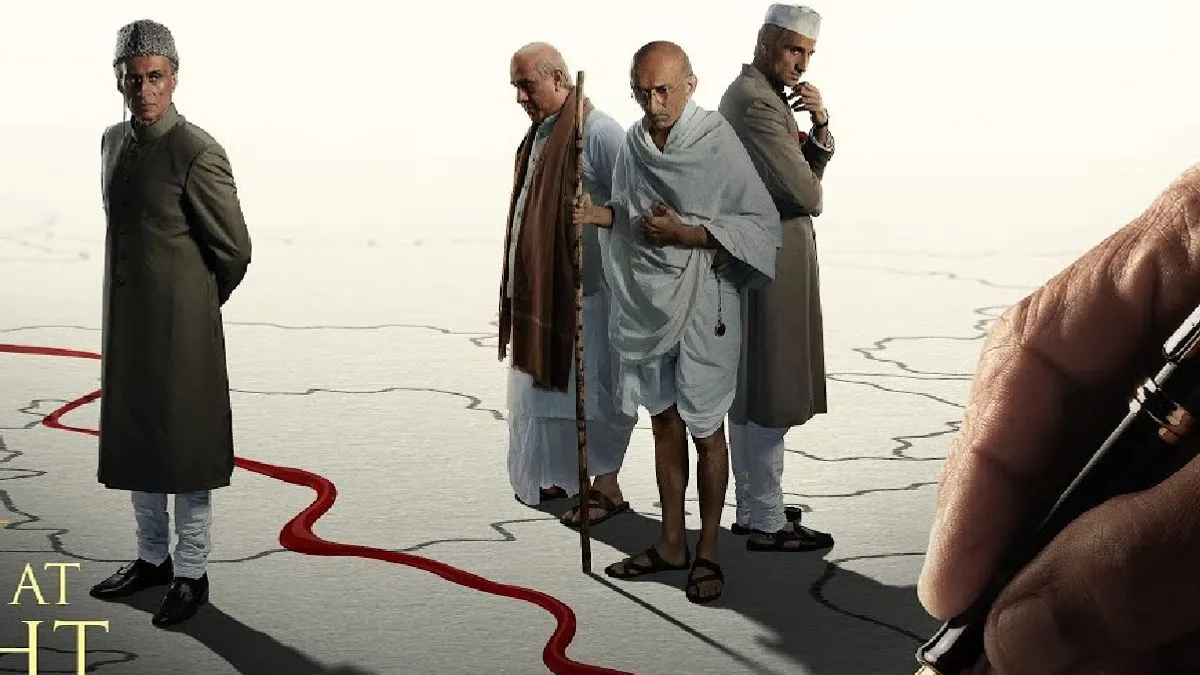

The new retelling revisits 1947 with a filmmaker’s eye and a historian’s conscience, squeezing the drama of partition, the romance of independence, and the stubborn question of secularism into powerful scenes. It asks familiar questions again: who led effectively, who failed morally, and how did ordinary people survive underneath great men and historic decisions?
A charged year: partition and independence
1947 is depicted not as a single moment but as a series of ruptures. Independence arrives like a long-awaited song — joyful, noisy, celebratory — while partition creeps in as a darker counter-melody: trains, burnings, and columns of refugees. The narrative balances statecraft with street-level grief, showing how maps and politics translated quickly into personal catastrophe.
- Political negotiation: The last British administration, regional leaders, and the Muslim League’s demands form the backdrop. Briefings, tense corridor talks, and Mountbatten’s clock become part of the drama.
- Human cost: Camps, makeshift shelters, abandoned homes and fractured families are foregrounded to remind us that history’s ink is written over blood and loss.
- Ambiguity: The story resists simple villains. Responsibility is shared between colonial mismanagement, communal mobilization, and leadership choices.
Secularism under the lens
Secularism in the 1947 context is not a tidy ideology but a contested promise. The retelling shows it as both aspiration and battlefield. Secularism is tested in courtrooms and temple courtyards, in refugee camps and in policy rooms.
Scenes emphasize different models of secularism:
- Principled secularism: A vision of the state that treats all citizens equally, regardless of religion — often associated with Nehru’s public rhetoric.
- Practical secularism: Everyday governance that must make compromises to keep peace, represented through administrative challenges and Patel’s hard choices.
- Religious identity politics: The push for separate electorates and a separate homeland for Muslims as an answer to fear and insecurity, central to Jinnah’s portrayal.
The creative team doesn’t offer easy answers. Instead, they frame secularism as fragile — an ideal that needed constant work and sacrifice, one that was stretched thin by fear and fast-moving events.
Portraits of leadership: close-ups and contrasts
The strength of the piece lies in its character study. The leaders of 1947 are shown in close-up: charismatic, stubborn, humane, flawed. Each portrait is a mixture of public persona and private doubt.
Nehru
The poet-statesman is shown with confident rhetoric and a cosmopolitan flair. His nationalist idealism and vision of a secular, modern India are central. The film captures his eloquence and the burdens that come with being the face of the new nation — the loneliness of leadership, moments of moral certainty, and the weight of expectation from millions.
Sardar Vallabhbhai Patel
The organizer and realist emerges as the iron-willed administrator, the one who wanted order above rhetoric. Scenes emphasize his focus on integration, refugee management, and practical governance. Patel’s portrait is less romantic and more procedural — a man who believed in the machinery of state to hold a fractured country together.
Mohammad Ali Jinnah
The resolute separatist is treated with a complex lens. The narrative shows Jinnah’s transformation from a nationalist colleague to the architect of a separate nation, driven by fear for Muslim security and political calculations. The portrayal avoids reducing him to caricature, instead presenting his determinations as both cause and consequence of communal breakdown.
Mahatma Gandhi
The moral conscience appears as a figure of restraint and moral persuasion. His insistence on non-violence and unity is presented as a powerful ethical stance — sometimes outmatched by practical realities. Gandhi’s scenes are quieter, built around symbolic acts and personal conviction rather than statecraft.
Narrative choices and cinematic flavor
As a storyteller, the production favors human moments over lecture. Instead of long expository speeches, we get a montage of camps, letters, and railway stations. Music and visual motifs — trains, partitioned maps, dimly lit negotiation rooms — carry emotional weight. This approach keeps the story moving while allowing viewers to feel the period’s urgency.
- Point of view: By shifting between leaders’ chambers and refugee tents, the work avoids privileging any single narrative, creating a mosaic rather than a single truth.
- Pacing: Rapid cuts during communal riots, slow takes during private conversations — this rhythm mirrors the unpredictability of those months.
- Emotional honesty: Small human scenes — a mother carrying a child, a leader pausing to read a casualty list — give the history its human scale.
Why this story still matters
Beyond historical curiosity, the retelling speaks directly to today’s debates about national identity, citizenship, and the promises of secularism. It reminds viewers that independence was not an endpoint but a beginning — one that required constant stewardship. The leadership choices of 1947 continue to shape political conversations, memory politics, and communal relations.
Final thoughts
This is a bold revisitation of a tumultuous year. By combining political analysis with cinematic storytelling, it encourages viewers to look beyond slogans and headlines. It invites empathy for ordinary people caught in history’s crossfire and asks us to judge leaders not only by speeches but by consequences. For anyone curious about 1947, the narrative is a compelling, often painful reminder that freedom and division were forged together — and that the work of keeping a diverse nation united began the moment the Union Jack came down.